

Americans Last
They chose to fight wars. They choose not to take care of us.

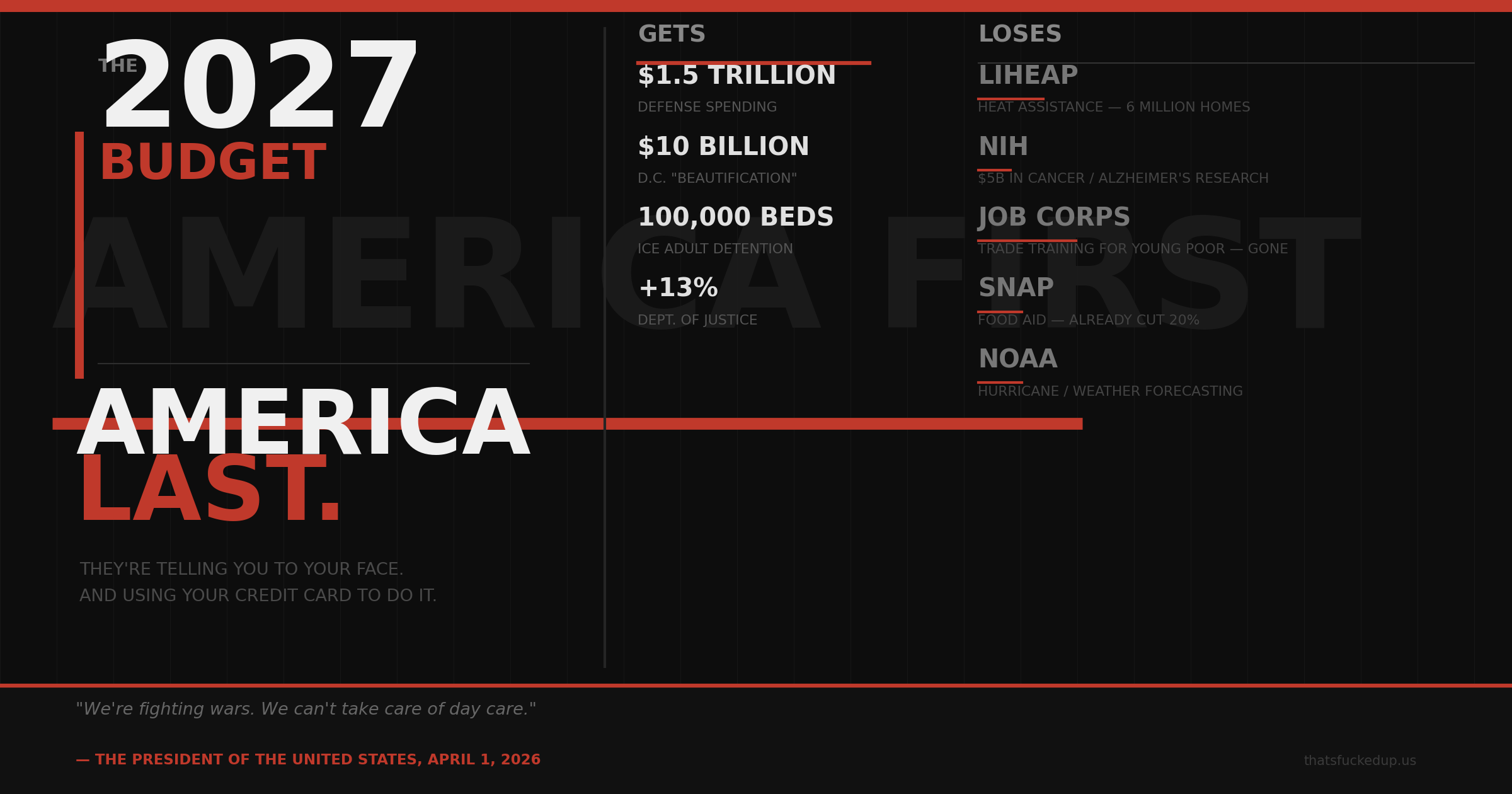
“We’re fighting wars. We can’t take care of day care.”
That was the President of the United States, speaking at a White House event on April 1st. Not as a lament. Not as an apology. As a policy statement.
“It’s not possible for us to take care of day care, Medicaid, Medicare — all these individual things. They can do it on a state basis. You can’t do it on a federal.”
Two days later, he released his 2027 budget. It asks for $1.5 trillion in defense spending, a 42% increase, the largest since World War II. It cuts non-defense programs by 10%. The document uses the word “woke” 34 times. Cultural grievance as fiscal policy.
Senator Patty Murray called it “morally bankrupt.” Rep. Brendan Boyle called it “America Last.”
They’re both right. But neither phrase captures what’s actually happening here. This isn’t just a bad budget. It’s the clearest statement yet of what Trumpism actually is: a movement that will bankrupt America to fund the machinery of coercion while telling Americans to their faces that they don’t deserve help.
What Gets the Money
The $1.5 trillion defense ask isn’t just about the Iran war, though the war provides convenient cover. (That war, launched February 28th without a congressional vote or a new Authorization for Use of Military Force, under executive authority alone.) $1.1 trillion would flow through normal appropriations. Another $350 billion through reconciliation, the party-line process that bypasses the 60-vote threshold. Using reconciliation to fund an unauthorized war means Republicans can pour money into a conflict most Americans never voted for, without a single Democratic vote required.
Beyond the Pentagon, here’s where the money goes:
100,000 ICE detention beds for adults and 30,000 for families. Sustaining the largest immigration detention system in American history, built out with last year’s $170 billion DHS expansion.
13% increase for the Department of Justice, focused on “migrant crime” and violent criminals.
$10 billion for “construction and beautification” in Washington, D.C. through the National Park Service.
Ten billion dollars for making the capital look nice. While cutting heating assistance for six million households.
What Gets Cut
Here’s the partial list of what Trump’s budget eliminates or slashes. These aren’t abstractions. These are the things that keep Americans alive, housed, fed, warm, educated, and employed.
Health:
Low Income Home Energy Assistance Program (LIHEAP): Eliminated. $4 billion gone. Six million households lose help paying heating and cooling bills. Elderly people, disabled people, families with kids. In Minnesota, where I live, winter without heat kills people.
HHS cut 12%, including $5 billion from the National Institutes of Health, the institution that develops treatments for cancer, Alzheimer’s, diabetes, and heart disease.
Agency for Healthcare Research and Quality: Cut $106 million. The administration says it “pushed radical gender ideology onto children.” It’s a medical research agency.
Hospital Preparedness Program: Cut $240 million. In the middle of a war that could escalate to chemical or biological weapons.
Multiple NIH institutes eliminated, including the National Institute on Minority Health and Health Disparities.
Housing:
HUD cut 13%. The HOME Investment Partnership Program — which builds affordable and low-income housing — eliminated. The Continuum of Care homeless assistance program gutted. Housing Opportunities for Persons with AIDS cut by $529 million. The Fair Housing Initiatives Program defunded.
No relief for the housing voucher waitlist. Not a dollar.
Food:
SNAP was already cut 20% — $186 billion through 2034 — in last year’s reconciliation bill. The average family losing SNAP benefits lost $146 per month. This budget continues that trajectory.
The McGovern-Dole Food for Education Program, which feeds children in developing countries, loses $240 million. Food for Peace, which sends aid during famines, loses $1.2 billion.
Education:
Over two dozen K-12 grant programs consolidated or eliminated — $8.5 billion total. Teacher Quality Partnerships, Migrant Education, English Language Acquisition, Equity Assistance Centers — all on the chopping block.
Job Corps: Gone. $1.6 billion. The program that trains young people, many from poverty, in skilled trades, wiped from the budget entirely.
Adult education eliminated. Minority-Serving Institution programs cut by $354 million.
Labor:
Senior Community Service Employment Program cut by $395 million. It employed low-income seniors.
OSHA training grants eliminated. The Office of Federal Contract Compliance defunded.
Environment:
$15.2 billion in clean energy programs canceled. NOAA cut by $1.6 billion. That’s the agency that tracks hurricanes, monitors fisheries, and runs weather forecasting.
The EPA Environmental Justice Program eliminated. The energy efficiency research office was already abolished.
Global Health:
Global Health Programs cut by $4.3 billion. WHO and Pan-American Health Organization funding eliminated entirely. Humanitarian assistance reduced by $2 billion.
The Receipts
Trump says we can’t afford these programs. This is a lie. The receipts prove it.
The national debt is $39 trillion. It was $19.9 trillion when Trump first took office in 2017. It has roughly doubled — under a president who promised to eliminate it within eight years.
To be fair about the arithmetic: Biden added to it too — roughly $4.7 trillion by the Committee for a Responsible Federal Budget’s count. But Trump’s first term alone added $8.4 trillion — nearly double Biden’s total. Roughly $2.5 trillion of that was tax cuts that overwhelmingly benefited corporations and the wealthy. Another $2.3 trillion was spending increases. The rest was pandemic relief and interest. And now he’s back, adding trillions more while claiming to be the fiscal conservative in the room.
Last July 4th — Independence Day — Trump signed the “One Big Beautiful Bill” reconciliation package. CBO scored it as adding $3.4 trillion to the national debt over ten years. The CBO estimated that bill would leave 10.9 million more people uninsured — 7.5 million from Medicaid cuts alone. It slashed SNAP by 20%. It gutted the ACA premium subsidies that made insurance affordable for millions.
And it included $150 billion for the Pentagon and $170 billion for immigration enforcement at DHS.
Now the 2027 budget asks for $1.5 trillion in total defense spending — a $445 billion increase over 2026 levels. And the projected deficit? The nonpartisan Committee for a Responsible Federal Budget estimates $19.5 trillion in deficits from 2026 through 2036 using the administration’s own figures — and calls the budget “light on details and heavy on borrowing,” relying on “an entire decade of rosy economic assumptions.” Even the conservative-leaning National Taxpayers Union notes that annual deficits remain above $1 trillion throughout the projection window.
Interest on the national debt is now projected to exceed $1 trillion this fiscal year. Nearly triple what it was in 2020. We’re spending more on interest than on defense. Over the next 30 years, the projected interest bill is $100 trillion.
Here’s what happened:
Cut taxes for corporations and the rich → blew up the debt
Used the debt as an excuse → “we can’t afford Medicaid, day care, housing”
Cut programs that help Americans → to fund military expansion and immigration enforcement
Repeat
Call it what it is: a wealth transfer. Money flows up to the wealthy through tax cuts and defense contracts. Money flows away from the poor, the sick, the elderly, and the hungry. The debt is the mechanism, not the problem. It’s the tool they use to justify taking things away from people who need them.
Who Benefits
A useful exercise: for every dollar in this budget, ask who it actually helps.
The $1.5 trillion for defense. Who benefits? Defense contractors. Lockheed Martin, Raytheon, Northrop Grumman. Their stock prices. Their shareholders. Their executives.
The 100,000 ICE detention beds. Who benefits? Private prison companies. GEO Group and CoreCivic, which operate most immigration detention facilities and have spent millions lobbying this administration.
The $3.4 trillion that last year’s reconciliation bill adds to the national debt. Who benefits? Corporations and the top income brackets got the tax cuts; working families got the Medicaid and SNAP reductions. The provisions that helped people — the expanded child tax credit, the ACA subsidies — were the first things cut.
The $10 billion for D.C. beautification. Who benefits? Construction firms. The president’s ego. The tourists who visit a city that looks nice while the country behind it crumbles.
Now ask who’s hurt:
The senior in Duluth who can’t pay her heating bill because LIHEAP was eliminated
The family in Detroit that loses $146/month in food assistance because SNAP was slashed
The kid in rural Mississippi whose school lost its English Language Acquisition program
The cancer researcher at NIH whose lab lost $5 billion in funding
The veteran whose VA benefits are administered by an agency gutted by DOGE
The young person in Appalachia who would have learned a trade through Job Corps, which no longer exists
“We’re fighting wars. We can’t take care of day care.”
He said it like it was obvious. Like it was natural law. Like the choice between bombs and baby formula was made by physics and not by him.
The Quiet Part
“We’re fighting wars. We can’t take care of day care.”
The honest version of that sentence is: “We chose to fight wars. We choose not to take care of you.”
That’s the quiet part. That’s the whole thing. This budget is the same story as everything else in Trumpism. The same pattern we see in trade, in diplomacy, in immigration. Coercion over cooperation. Punishment over investment. Control over care. It funds the things that hurt people (wars, deportation, detention, surveillance) and cuts the things that help them (health care, housing, food, education, clean energy, scientific research).
And it does all of this on borrowed money. Money our children and grandchildren will pay back in interest. Money borrowed not to build schools or cure diseases or house the homeless, but to fund an unauthorized war, fill detention centers, and pour $10 billion into D.C. construction and beautification projects.
Trumpism is pro-power. It will spend unlimited money on the instruments of force and tell you there’s nothing left for the instruments of care.
There’s always money for another bomb. Never money for your kid’s school.
There’s always money for another detention bed. Never money for your grandmother’s heating bill.
Trump promised to eliminate the national debt. He doubled it. He promised to make America great. He’s making it broke, sick, hungry, and afraid, while calling it strength.
They’re telling you to your face, and they’re using your credit card to do it.
Keep the list. thatsfuckedup.us
References
“Trump budget seeks $1.5T in defense spending alongside cuts in domestic programs” — Associated Press, April 3, 2026
“Trump’s 2027 budget asks Congress for $1.5 trillion in defense spending, with 10% cuts elsewhere” — CBS News, April 3, 2026
“An Overview of the President’s FY 2027 Budget” — Committee for a Responsible Federal Budget (nonpartisan), April 2026
“CRFB Statement on President’s FY 2027 Budget” — Committee for a Responsible Federal Budget (nonpartisan), April 2026
“A $1.5 Trillion Defense Budget Could Mean Nearly $7 Trillion in Higher Debt” — Committee for a Responsible Federal Budget (nonpartisan), March 2026
“Trump’s Budget Offers a Mixed Bag for Taxpayers” — National Taxpayers Union (conservative-leaning), April 2026
“Trump Goes After Programs He Calls ‘Woke’ in Budget Proposal” — New York Times, April 3, 2026
“List of programs Trump 2027 budget proposal would cut” — Newsweek, April 3, 2026
“Trump’s 2027 new budget proposal: 5 key cuts and investments to know” — Axios, April 4, 2026
“Senator Murray on President Trump’s FY27 Budget Request” — U.S. Senate Appropriations Committee, April 3, 2026
“Trump budget seeks $1.5 trillion in defense spending alongside domestic program cuts” — NPR, April 3, 2026
“How Will the 2025 Reconciliation Law Affect the Uninsured Rate in Each State?” — Kaiser Family Foundation (nonpartisan), November 2025; based on CBO estimates
“New CBO estimates show 2025 reconciliation bill would have impacts similar in magnitude to 2017 ACA repeal bills” — Brookings Institution, June 2025
“Trump’s big beautiful bill cuts food stamps for millions” — CNBC, July 10, 2025
“The national debt just crossed $39 trillion — almost doubling since Trump vowed to erase it” — Fortune, March 18, 2026
“As national debt nears $39 trillion and Trump promises to balance budget, Americans spend more on interest payments than on defense” — The Spokesman-Review (CRFB data), March 6, 2026
“10 Years Ago Today, Trump Promised To Eliminate the National Debt. Instead, It Has Doubled.” — Reason (libertarian), March 31, 2026
Deficit Tracker — Bipartisan Policy Center (nonpartisan), updated April 2026
“Trump just raised the $39 trillion national debt with the largest budget hike since World War II” — Fortune, April 3, 2026
“Civilian agencies face 10% cuts in Trump’s 2027 budget” — Government Executive, April 4, 20